
How to Create Amazon Image URLs for Flat Files Quickly – A Beginner’s Guide
Uploading images to Amazon product listings is a critical step in optimizing your Amazon store. Sellers can manually upload images or use bulk upload methods through flat files. Traditionally, many relied on third-party websites to generate direct image links, but these services were often unreliable. Fortunately, there's a better alternative — using Google Drive links directly in flat files.
In this guide, we'll show you how to efficiently upload product images to Amazon using Google Drive, eliminating third-party tools and streamlining your workflow. We also cover how to extract existing Amazon product image URLs from any ASIN — a separate but equally important skill for catalog management and competitor research.
How to Upload Images on Amazon the Old Way

Previously, Amazon sellers had to go through a tedious process to generate direct image links for bulk uploads:
- Download images from Google Drive – Sellers first had to download their images onto their local device.
- Upload to a third-party website – To get a direct link, images were uploaded to a third-party tool.
- Copy and paste the direct link into a flat file – Once the links were generated, they had to be manually inserted into Amazon's flat file template.
This method was time-consuming and often led to errors, such as broken links or failed uploads due to unsupported URLs.
How to Upload Images on Amazon the New Way
Instead of relying on unreliable third-party services, Amazon sellers can now use Google Drive to create direct image links for flat files. This method is faster, more efficient, and ensures that the links remain functional.
By using Google Drive links, sellers can:
- Save time on bulk image uploads
- Reduce dependency on third-party services
- Minimize errors in the Amazon flat file image upload process
Let's go through the step-by-step process of generating a direct link from Google Drive that Amazon will accept.
How to Use Google Drive Link in a Flat File

Follow these steps to convert a Google Drive link into a direct image URL that can be used in an Amazon flat file:
Step 1: Copy the Google Drive Link
- Open your Google Drive and locate the image you want to upload
- Right-click on the image and select Get Link
- Set the access to Anyone with the link can view
- Copy the link
Step 2: Convert the Google Drive Link into a Direct Link
The default Google Drive share link will look something like this:
https://drive.google.com/file/d/1ABCDEFG1234567890/view?usp=sharing
To create a direct link, use the following formula:
- Paste the Google Drive link into cell A2 in your spreadsheet.
- In cell B2, enter the following formula:
=CONCATENATE("https://drive.google.com/uc?export=view&id=", MID(A2, 33, 33))
This formula extracts the file ID from the Google Drive link and generates a direct image URL.
Step 3: Insert the Direct Link into Your Amazon Flat File
- Copy the newly generated direct link from cell B2
- Paste it into the image URL column in your Amazon flat file
- Save and upload the flat file to Amazon Seller Central
Prefer a video walkthrough? We've put together a step-by-step tutorial on this exact process — check it out on our videos page.
How to Create Image URLs for Flat Files Using a Template
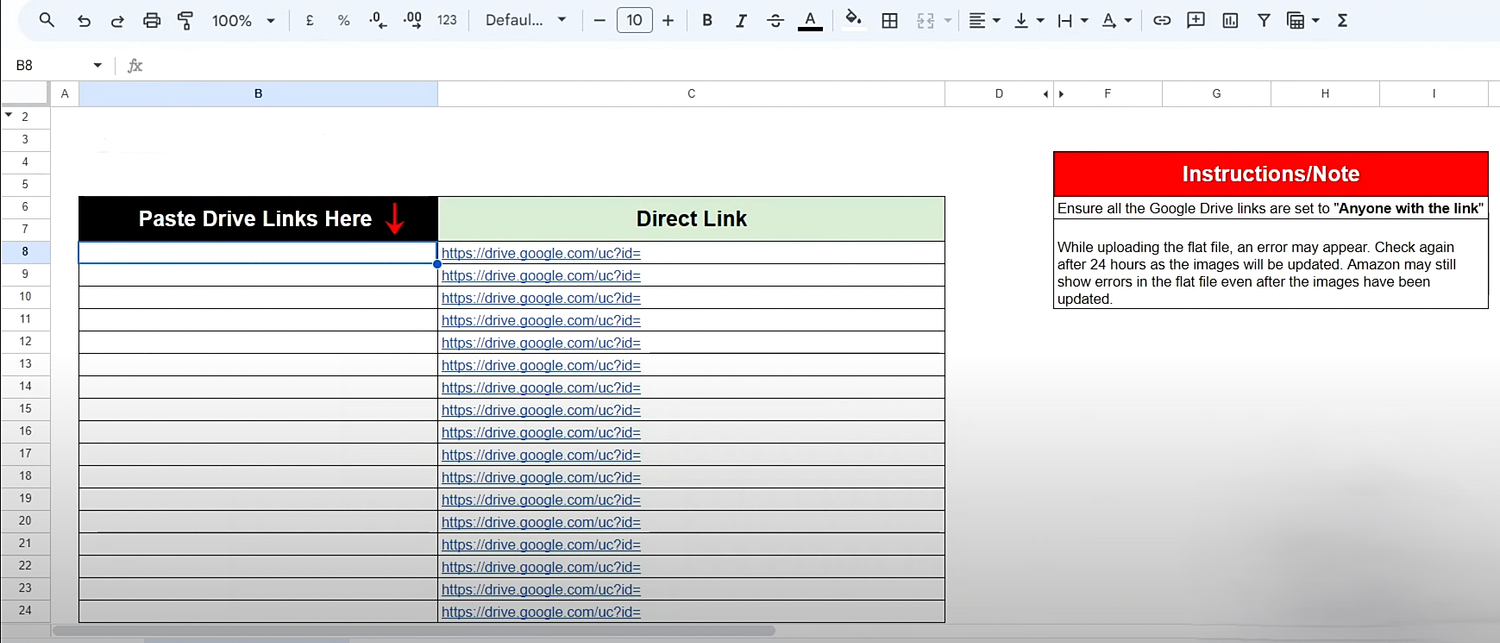
To make the process even easier, we at YourSeller have created a pre-built template for converting Google Drive links into direct image URLs. Here's how you can use it:
- Download the template – Contact us to get access to our pre-made Google Sheets file
- Paste your Google Drive link into the designated column
- The template will automatically generate a direct link for you to use in your Amazon flat file
Troubleshooting Amazon Flat File Image Upload Errors
Even after following the correct steps, Amazon may still show errors during image uploads. Here are some common issues and their solutions:
Amazon Flat File Image Errors and Solutions
Error: Image not updating after flat file upload
Solution: Amazon's system may take up to 24 hours to process image updates. Wait and check later.
Error: Invalid image URL format
Solution: Ensure the link is in the correct format: https://drive.google.com/uc?export=view&id=FILE_ID
Error: Broken image link after upload
Solution: Verify that the Google Drive file is shared with public view access. If images repeatedly fail to load after upload, it may also trigger listing suppression issues — check our guide on why Amazon listings stop showing.
Fix Amazon Image Upload Errors
- Double-check that the flat file is correctly formatted
- Use Google Sheets' formula to avoid manual errors
- If an image fails to appear, try re-uploading it
Amazon Listing Optimization with Images
High-quality images are essential for Amazon listing optimization. Here's how optimized images improve your listing:
- Higher conversion rates – Clear, professional images increase sales
- Better rankings – Amazon's algorithm favors listings with high-quality images
- Improved customer trust – Well-optimized images reduce returns and negative reviews
How to Get Amazon Product Image URL from an ASIN
Uploading images is one side of the coin. The other is knowing how to pull an existing product image URL directly from a live Amazon listing — something sellers regularly need for competitor research, catalog audits, A+ content reviews, or price comparison tools. Here are three ways to do it.
Method 1: Right-Click on the Product Image (Fastest)
- Open the Amazon product listing page for the ASIN you need
- Hover over the main product image until it zooms in
- Right-click on the zoomed image
- Select Copy Image Address (Chrome/Edge) or Copy Image Location (Firefox)
- Paste the URL — it will look like:
https://m.media-amazon.com/images/I/XXXXXX._AC_SL1500_.jpg
This gives you the direct, publicly accessible image URL hosted on Amazon's CDN. You can modify the size parameter to get different resolutions — replace _SL1500_ with _SL1000_ for a 1000px version, or remove the suffix entirely for original full resolution.
Method 2: Understanding Amazon's Image URL Structure
Amazon image URLs follow a consistent structure you can use to modify or reconstruct image links:
https://m.media-amazon.com/images/I/[IMAGE-CODE].[MODIFIER].jpg
| URL Component | What It Controls | Example |
|---|---|---|
m.media-amazon.com/images/I/ |
Amazon's image CDN base path | Fixed — same for all Amazon images |
Image Code (e.g., 71XYZ123AB) |
Unique identifier for the image file | Extracted via right-click or Seller Central |
._AC_SL1500_ |
Size modifier — 1500px longest side | Change to _SL500_ for 500px thumbnail |
._AC_ |
Auto-crop flag — removes white padding | Remove for uncropped original version |
Method 3: Using Amazon Seller Central — Manage Images
If you manage the listing, Amazon Seller Central provides the most direct access to all image URLs for your ASINs:
- Log in to Seller Central → Inventory → Manage All Inventory
- Find the ASIN → click Edit
- Go to the Images tab
- Right-click any image shown → Copy Image Address to get its live CDN URL
This method is especially useful for auditing all 9 image slots — checking which are filled, which have outdated images, and which URLs are currently live on the product detail page.
How to Fetch Amazon Product Image URLs in Bulk
For sellers managing large catalogs who need image URLs from hundreds of ASINs at once:
- Amazon Listing Report: For sellers using FBA inventory management, downloading the Listing Report from Seller Central → Reports → Inventory Reports gives you image URL columns for all active ASINs in one spreadsheet.
- Amazon SP-API (Listings Items API): Developers can use Amazon's Selling Partner API to programmatically fetch image URLs for any ASIN. As of 2025, Amazon has been transitioning bulk catalog management to SP-API — making it the most future-proof method for high-volume image URL retrieval.
- Browser DevTools: Open F12 → Network tab → filter by "image" → reload the page → identify the largest image file loaded. This shows exactly which image Amazon is currently serving for that ASIN.
Best Image Hosting Options for Amazon Flat Files (2026 Update)
The Google Drive method works well for most sellers starting out. But before you use it for a 500-ASIN bulk upload, it's worth knowing where it can let you down — and what the safer alternatives are.
Amazon's image processing system fetches image URLs directly from the source during flat file processing. If the URL has authentication layers, redirects, or gets rate-limited, the upload fails silently — you may only discover the problem when you check the processing report hours later.
| Hosting Method | Works for Flat Files? | Best For | Watch Out For |
|---|---|---|---|
| Google Drive (with formula) | ✅ Yes — with direct URL conversion | Small to medium catalogs, free option | Files must stay public; deleting source breaks URLs |
| Amazon S3 (AWS) | ✅ Yes — most reliable | Large catalogs, agencies, high-volume sellers | Requires AWS account; small monthly storage cost |
| Dropbox (shared link) | ⚠️ Unreliable | — | Serves via redirect, not raw file — Amazon rejects |
| Google Photos | ❌ Does not work | — | Amazon explicitly rejects Google Photos URLs |
| Imgur / Postimages | ⚠️ Intermittent | Quick testing only | Policy changes and link expiry cause failures |
| Dedicated CDN (img.vision etc.) | ✅ Reliable | Sellers needing stable, long-term URLs | Paid plans for high volume; verify Amazon compliance |
Key rule: The URL must return a raw image file directly — no redirects, no login prompts, no authentication layers. If the URL requires any intermediate step to reach the image file, Amazon's servers will reject it during flat file processing.
Amazon Listing Image Requirements (Updated 2026)
| Requirement | Amazon Standard |
|---|---|
| Minimum image size | 1,000 × 1,000 pixels (enables zoom) |
| Recommended size | 2,000 × 2,000 pixels for best zoom quality |
| Main image background | Pure white — RGB (255, 255, 255) |
| Accepted file formats | JPEG, PNG, TIFF, GIF (non-animated only) |
| Maximum file size | 10 MB per image |
| Image slots per listing | Up to 9 total (1 main + 8 additional) |
| Text / watermarks on main image | Not permitted — causes listing suppression |
| Secondary images | Lifestyle, infographic, and detail shots allowed |
Filling all 9 image slots signals a complete, high-quality listing to Amazon's algorithm. Listings with fewer than 6 images are at a disadvantage in search ranking compared to fully optimized listings in the same category.
Frequently Asked Questions (FAQs)
How do I get the image URL from an Amazon product listing using the ASIN?
Go to the product page, hover over the main image to trigger zoom, right-click and select "Copy Image Address." The URL follows Amazon's CDN format: https://m.media-amazon.com/images/I/[IMAGE-CODE]._AC_SL1500_.jpg. You can modify the size suffix to get different resolutions. For bulk extraction across multiple ASINs, download a Listing Report from Seller Central → Reports → Inventory Reports — it includes image URL columns for all your products in one spreadsheet.
Can I use Google Drive links directly in Amazon flat files?
Not the standard sharing link — you must convert it first. The default Google Drive sharing link does not work because Amazon cannot follow its redirect. Convert it using the formula: =CONCATENATE("https://drive.google.com/uc?export=view&id=", MID(A2,33,33)). This generates a direct image URL Amazon can fetch during flat file processing. The file must also have "Anyone with the link" sharing access enabled before uploading.
Why is Amazon not accepting my image URL in the flat file?
The most common causes are: (1) the URL is a sharing page link rather than a direct image file link, (2) the hosting source uses redirects or authentication that Amazon's servers cannot follow, (3) the image format is WebP or AVIF instead of JPEG/PNG/TIFF, or (4) the file is no longer publicly accessible. Google Photos URLs and standard Dropbox sharing links are both rejected by Amazon — use the Google Drive direct link formula or AWS S3 instead.
Does Amazon still support flat file image uploads in 2026?
Yes, flat file uploads via Seller Central remain fully supported. However, Amazon has been expanding its SP-API and encouraging high-volume sellers to transition to the Listings Items API for bulk catalog management, which offers faster processing and real-time error feedback. For most sellers managing under a few hundred ASINs, flat files continue to work reliably.
Can I use Google Photos links instead of Google Drive for Amazon flat file image uploads?
No. Amazon does not recognize Google Photos links as direct image URLs. Google Photos requires authentication to access the actual image file, which Amazon's servers cannot complete during flat file processing. Only Google Drive links converted to the direct format (drive.google.com/uc?export=view&id=FILE_ID) will work in Amazon flat files.
Will my Amazon images disappear if I delete the source files from Google Drive?
Once Amazon has successfully processed and hosted an image, it is stored on Amazon's own CDN servers. Deleting the Google Drive source file after a confirmed successful upload will not remove the image from your live listing. However, keep source files in Google Drive until you confirm the images are displaying correctly on the product detail page — if Amazon needs to re-fetch during processing, a deleted file will cause an upload failure.
You Can Count On Our Amazon Product Listing Services
Struggling with image uploads or managing image URLs across a large catalog? At YourSeller Agency, we handle end-to-end Amazon listing and cataloging — including image compliance, flat file management, and marketplace management for brands selling in the US and India.
Our 90-day sprint model means measurable results without long-term contracts. No fluff, just execution.
