
How to Effectively Track Reviews on Amazon for Better Product Performance
Your best-selling ASIN just dropped from 4.6 stars to 4.2 in a week, and nobody on your team noticed until sales slid. That's what happens when you don't track Amazon reviews with any real system. You find out about a problem after it has already cost you rank and revenue.
Amazon treats review volume and rating as trust signals inside its ranking system. A small shift can move a listing several positions in search. Sellers who track Amazon reviews consistently catch these shifts early. They tie the shift to a specific cause and fix the listing before Amazon's algorithm, or the next shopper, notices.
Tracking Amazon reviews means monitoring review count, star rating, and review content per ASIN over time using Seller Central data, then comparing periods to spot meaningful shifts. It differs from simply checking your star rating — it's a repeatable process that connects rating changes to specific causes like packaging, sizing, or a supplier switch.
This matters because Amazon's ranking algorithm treats review signals as a proxy for product quality and customer satisfaction. A slow decline in rating, or a sudden spike in negative themes, can quietly push a listing down in search results. This often happens weeks before your sales data shows the damage. Sellers who build a tracking habit around this catch the pattern early enough to fix the actual issue, rather than reacting after conversion rate has already dropped.
Why Does Review Tracking Actually Move Your Amazon Rankings?
Amazon doesn't publish an exact ranking formula, but sellers and researchers agree that review count and average rating function as trust signals inside it. A product with fewer than 15 reviews still converts noticeably worse than a similar listing with 15 or more reviews at 4.0 stars or higher. Seller research communities have documented this gap repeatedly. That difference alone explains why a once-a-month rating glance isn't enough.
The real value of tracking Amazon reviews shows up in the pattern, not the snapshot. A listing that drops from 4.6 to 4.3 stars over two weeks is telling you something specific happened. It could be a packaging change, a batch quality issue, a supplier switch, or even a variation-sharing change on Amazon's side. Catching that shift within days, instead of a full sales cycle later, makes the difference. It's the gap between a quick fix and a rank recovery that drags on for months.
In practice, the sellers who handle this well treat review data the same way they treat PPC or inventory numbers. It becomes a recurring report, checked on a schedule, compared against a prior period. Ad hoc glances at the storefront rating don't surface trends. They only confirm what's already visible on the product page, usually after the damage is done.
The Tools and Templates You Need to Track Amazon Reviews Properly
Amazon Seller Central is the primary source for this data. It houses your Business Reports, order history, and, for brand-registered sellers, Brand Analytics. Seller Central gives you the raw numbers, but it doesn't compare periods, flag trends, or organize data by ASIN automatically. That's the gap a tracking template fills.
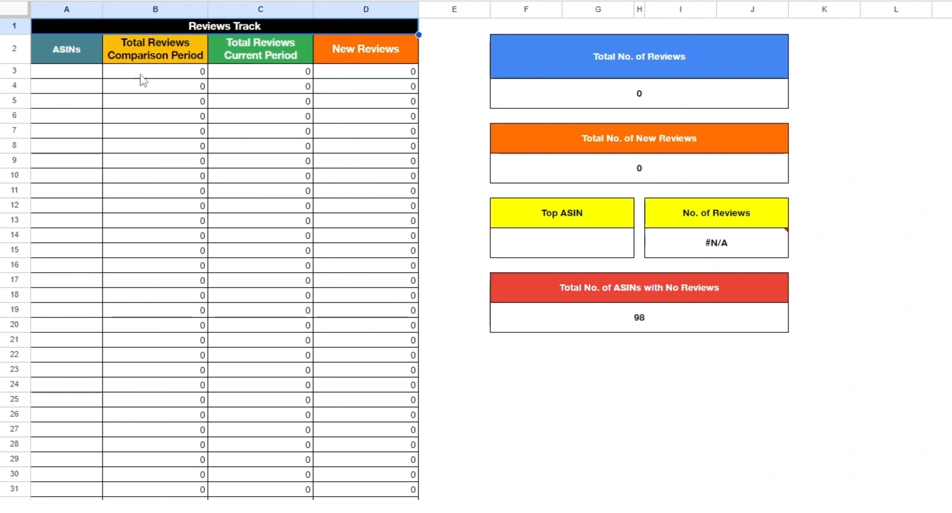
A proper ASIN-level review tracking template does three things a raw Seller Central screen doesn't. It stores review counts side by side across two time periods. It calculates the change automatically, and flags which ASINs gained the most, or lost ground, since the last check. Build this in a spreadsheet with columns for ASIN, product name, current-period review count, comparison-period review count, and the calculated difference. That structure alone catches most meaningful shifts without needing paid software.
If you're managing more than 20-30 ASINs, a paid tool like Helium 10 or DataDive can automate the pull. The template still does the actual analytical work either way. The tool just saves the manual download-and-paste step.
How to Track Amazon Reviews Step by Step
Step 1: Gather Your Product ASINs
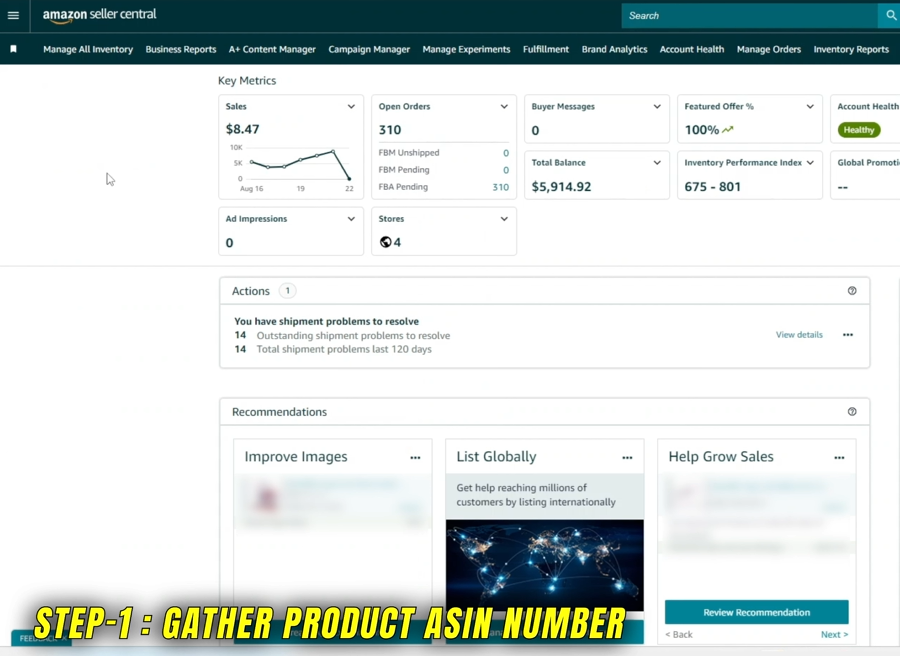
Start by logging into Seller Central and navigating to Business Reports. Download the report for your current period. Then download a second report for whatever comparison period you want to measure against — usually the prior 30 or 90 days.
Pull a full ASIN list from these reports rather than working from memory. Sellers managing 40 or more SKUs consistently miss low-review, low-visibility ASINs when they track only their top performers. Those are often the listings that need the most attention, since they have the least review volume providing rating stability.
Step 2: Prepare the Data
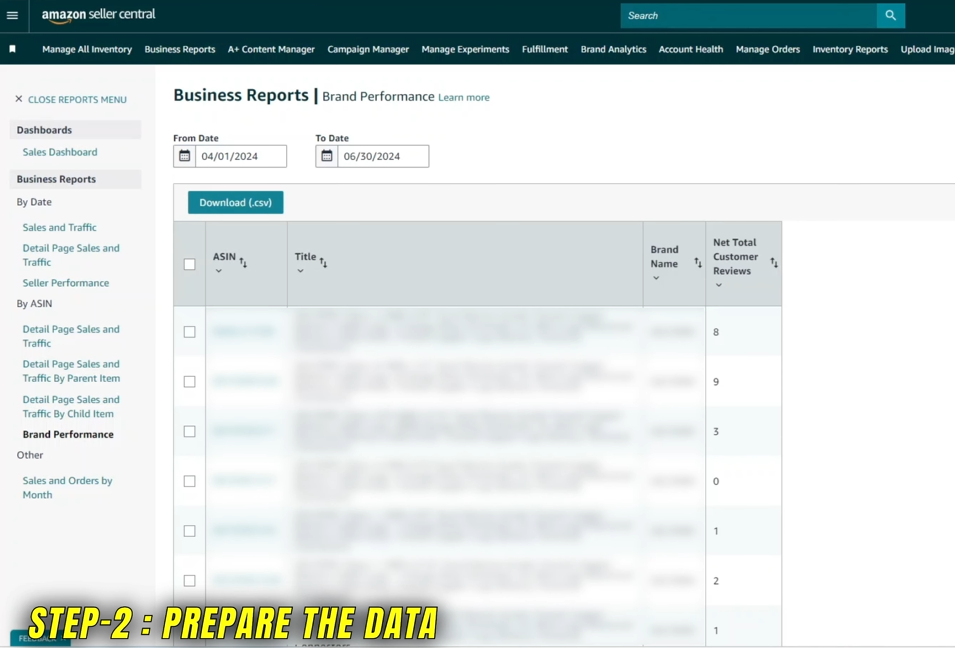
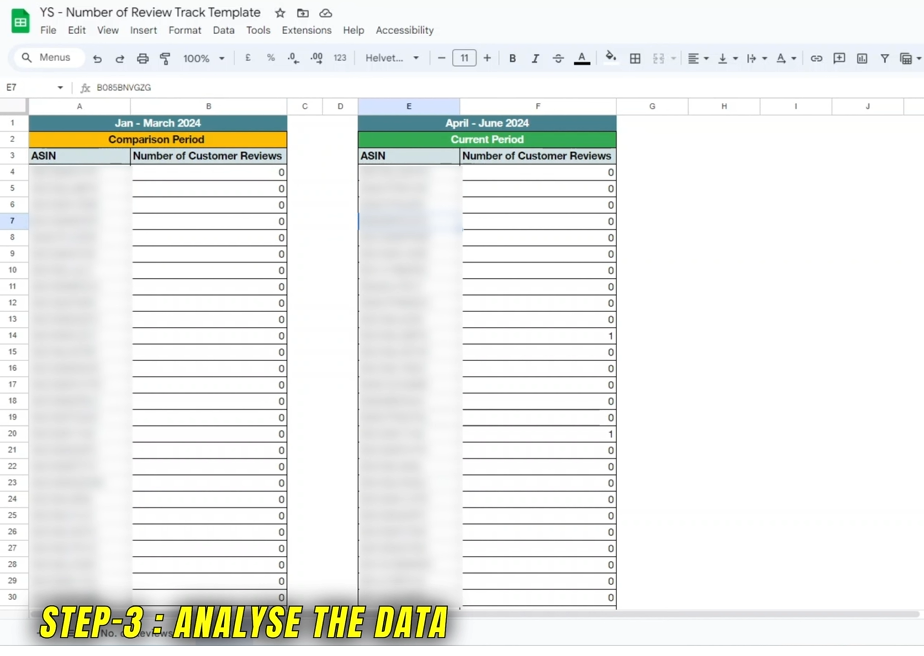
Open the current period's report, locate the ASIN and review count columns, and copy them into the data sub-sheet of your tracking template under the current-period columns. Repeat the process with the comparison period's report, pasting into the corresponding comparison columns.
By the end of this step, every ASIN you're tracking should have two review counts sitting side by side, with no calculations yet. You just need clean, matched data ready for analysis.
Step 3: Analyze the Data
With both periods populated, your template should calculate total reviews per period, new reviews gained, and which ASINs picked up the most, or lost, review volume. Add a simple flag column for any ASIN showing zero new reviews across two consecutive check-ins. Those listings usually need a review-generation push, not a tracking fix.
This is also where the pattern from the ranking section becomes visible. Watch for a high-review ASIN that suddenly shows a rating dip alongside flat or negative review growth. That combination, not either metric alone, is what typically signals a real product or listing problem worth investigating.
Turning Review Data Into a Monitoring System That Catches Problems Early
Tracking counts and ratings tells you something changed. It doesn't tell you why, or whether it's worth acting on. That's where a review monitoring log, distinct from the tracking template above, earns its place in your workflow.
| Field | What to Record |
| Issue Theme | e.g. "lid leaks," "size runs small" |
| Frequency | Number of mentions within a set window (e.g. 2 weeks) |
| Severity | Low / Medium / High, based on impact to usability or safety |
| Affected ASIN/Variation | Specific ASIN or variation the theme is tied to |
| First Seen | Date the theme first appeared in a review |
| Owner | Team member responsible for investigating |
| Action Taken | Packaging change, listing edit, supplier follow-up, etc. |
| Status / Validation Date | Open, resolved, or monitoring, with a follow-up date |
Log every recurring theme you see in review content, not just the star rating. A pattern like "lid leaks" appearing in three reviews within two weeks is a specific, checkable signal. Your template's raw numbers won't surface that kind of pattern on their own. Assign an owner and a follow-up date for each theme so it doesn't sit unresolved after the initial flag.
When a theme escalates, that's the point to move from monitoring into active response. Escalation looks like more mentions, higher severity, or a rating drop tied to the same issue. That could mean a packaging fix, an updated listing description, or a structured recovery plan for a rating already trending down. Our guide to handling 1-star reviews on Amazon walks through those next steps.
What Amazon's 2026 Variation-Sharing Changes Mean for Your Tracking
Amazon updated how reviews share across product variations twice in 2026, on February 12 and again on May 31, changing which variation themes qualify for shared review counts. Tracking reviews at the parent ASIN level without accounting for this creates a blind spot. A variation that gained reviews through sharing can look like organic growth in your template when it isn't.
Check your variation eligibility periodically rather than assuming it's fixed. Amazon's Seller Assistant tool shows which variations currently qualify for shared reviews. It's a small detail most tracking guides skip, but it directly affects whether the numbers in your template mean what you think they mean.
Reviews move faster than most sellers check them. By the time a rating drop shows up in your sales dashboard, you've usually already lost weeks of visibility you won't get back. The fix isn't complicated — it's consistency. Track Amazon reviews on a fixed schedule. Log the actual themes behind rating shifts, and treat variation-level nuances as part of the process, not an afterthought. Sellers who build this into a weekly habit catch problems while they're still small enough to fix in a day, not a quarter.
Frequently Asked Questions
How often should I track Amazon reviews?
Weekly is the practical minimum for active listings. Amazon updates review counts continuously, and a two-week gap between checks can hide a fast-moving trend. High-volume ASINs benefit from a quick daily glance at new review counts, even if the full comparison template only gets updated weekly.
What's the difference between review tracking and review monitoring?
Tracking is the numbers — review count and rating compared across periods. Monitoring goes further. It logs the actual themes inside review content, like a recurring complaint or a specific defect. That way you know why a number moved, not just that it did.
Can I track reviews separately for each product variation?
Yes, but Amazon's variation review-sharing rules affect what you're actually measuring. Since the February and May 2026 updates, some variations share pooled review counts while others don't. Check current eligibility in Seller Central before assuming a variation's review count reflects its own individual sales.
Which Seller Central report shows review counts by ASIN?
Business Reports gives you sales and traffic by ASIN. Review counts specifically come from the Customer Reviews section under Brands for brand-registered sellers, or from checking star ratings directly on each listing. Neither report calculates period-over-period change on its own, which is why a tracking template matters.
What review trend actually needs action, versus normal fluctuation?
A single negative review rarely signals a real problem. Watch for a repeated theme instead — the same complaint appearing three or more times within a couple of weeks. Combined with flat or declining new-review volume, that pattern is worth investigating, not one isolated low rating.
Do paid tools like Helium 10 replace manual review tracking?
They speed up the data pull for sellers managing large catalogs, but they don't replace the analysis step. You still need to decide what counts as a meaningful shift and assign someone to act on it. The tool automates collection, not judgment.
Ready to Turn Your Amazon Review Data Into a Growth Strategy?
Tracking reviews consistently is only half the work — acting on what the data shows is what actually protects your rank and conversion rate. Pulling reports, building templates, and triaging review themes across dozens of ASINs takes real time every week. That's exactly the kind of ongoing account management an Amazon sales agency like YourSeller handles for sellers across India, the UK, and the USA.
Our team builds the tracking systems, flags the ASINs that need attention, and connects review data to the product listing or advertising fix that actually moves the number. Reach out to YourSeller at +1 510-648-3933 (USA) or +91 9909513312 (India), email contact@yourseller.in. We'll show you what your review data is already telling you.
