
Last Updated: November 2026 | By Shaival Choksi, YourSeller Agency
Amazon renamed its AI shopping assistant from Rufus to Alexa for Shopping in January 2026 — and with the rebrand came a deeper integration with the main Alexa platform, expanded query types, and a more prominent placement across the Amazon app. If you have been optimizing your listings for traditional keyword search alone, your products are likely being left behind in a growing share of purchase-intent queries that now run through this AI layer.
What is Alexa for Shopping (formerly Amazon Rufus)?
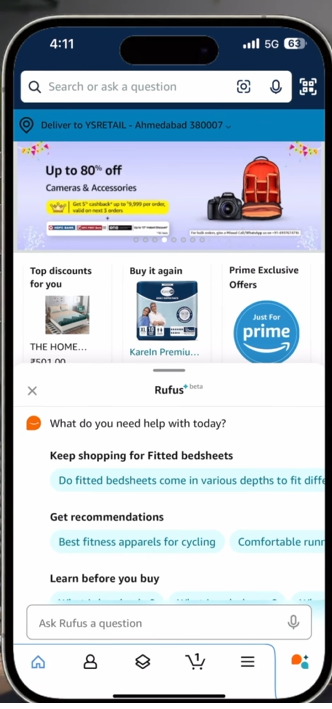
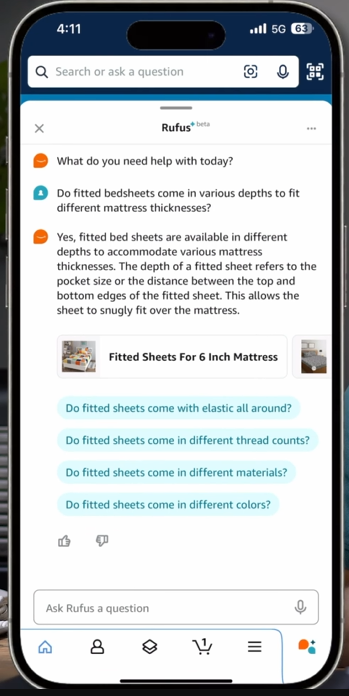
Alexa for Shopping is Amazon's conversational AI shopping assistant, launched as Rufus in early 2024 and rebranded in January 2026. It answers natural-language product questions, makes personalized recommendations, and helps shoppers compare, filter, and buy products using conversational prompts rather than keyword searches. It is powered by Amazon's proprietary COSMO reasoning model and pulls answers directly from listing content, reviews, Q&A sections, and category knowledge.
What sellers need to know about Alexa for Shopping — at a glance:
- It reads your title, bullets, description, A+ Content, Q&A, and reviews simultaneously
- It ranks products by intent match, not keyword density
- It is powered by COSMO, an AI reasoning model that understands product use cases
- It is not replacing keyword search — it runs in parallel as a separate discovery layer
- Products with thin content, missing Q&A, and few reviews are significantly under-represented in AI-driven results
- Optimization for Alexa for Shopping and optimization for traditional A9/A10 search are mostly complementary — not at odds
What Is Amazon COSMO — the Engine Behind Alexa for Shopping?
When a shopper types "what's a good protein shaker for someone who travels a lot?" into Alexa for Shopping, they are not running a keyword search. That query has no product title match, no exact-phrase overlap. What surfaces a product here is COSMO.
COSMO (Common Sense Knowledge System) is Amazon's proprietary AI reasoning model that powers Alexa for Shopping's product selection. Amazon published research on COSMO in 2023, describing it as a large-scale knowledge system trained to infer common-sense relationships between products and use cases. The model understands that someone "who travels a lot" needs something leakproof, compact, and easy to clean — it bridges the gap between how customers think about their needs and how products are described in listings.
Traditional A9 and A10 search rewards keyword relevance and purchase velocity. COSMO rewards what Amazon's research calls "feature-to-need alignment" — does your listing explain not just what the product is, but when and why a customer would use it, and what problem it solves? A listing that says "BPA-free 24oz shaker bottle with leak-proof lid — ideal for gym, travel, and outdoor use" gives COSMO the use-case context it needs to surface that product for travel-related queries. A listing that says only "24oz shaker bottle, blue, stainless" does not.
The practical implication: COSMO is not reading your backend keywords. It is reading your visible content — titles, bullet points, descriptions, A+ Content brand story panels, Q&A entries, and review text — and constructing a mental model of what your product is for, who uses it, and in what situations. Every field you leave vague or empty is a gap in that mental model.
How Does Alexa for Shopping Decide Which Products to Recommend?
How does Alexa for Shopping choose products?
Alexa for Shopping selects products by matching the customer's expressed intent against the use-case signals in a listing's content, reviews, and Q&A. It considers listing quality (completeness, clarity, review volume), relevance to the specific need described, and purchase history signals. Products with richer, more specific content — including real customer language in reviews and answered Q&A — consistently receive more recommendations than keyword-optimized but content-thin listings.
There are four primary signals Alexa for Shopping weights when deciding what to surface:
1. Listing Completeness
COSMO needs data to reason from. A listing missing its description, with only two bullet points, or with an empty A+ Content slot gives the model fewer signals to match against customer queries. Amazon's internal documentation for Brand Registry sellers specifically recommends filling all available content fields — including non-mandatory category-specific attributes — precisely because these feed AI-powered recommendations. Think of completeness as the floor: you cannot win on AI search with an incomplete listing.
2. Use-Case Clarity in Titles and Bullets
The shift from keyword matching to intent matching means your title and bullets need to answer "who is this for and when would they use it?" — not just "what is it?" A title structured as [Brand] + [Product Type] + [Key Feature] + [Use Case] performs significantly better in Alexa for Shopping results than a title that stops at features. "YourBrand Resistance Band Set — Non-Slip Fabric, Light to Heavy Resistance — for Home Gym, Physical Therapy, and Travel Workouts" gives COSMO four distinct use-case contexts. A title that just says "fabric resistance bands 5 pack" gives it one.
3. Customer Reviews and Q&A as AI Training Signals
This is the signal most sellers underestimate. COSMO processes review text and Q&A entries as first-person use-case descriptions, written in natural customer language. When reviewers write "perfect for my morning commute," "my physical therapist recommended this," or "fits in my carry-on," those phrases map directly to conversational search queries. A product with 200 detailed reviews is effectively training Alexa for Shopping on 200 different use-case descriptions. A product with 8 one-line reviews is not.
The same applies to Q&A. Unanswered questions leave gaps. Answered questions, especially those written with specificity ("Can this blender handle frozen fruit? Yes — the 1200W motor handles ice and frozen berries without stalling. We use it for daily smoothies"), add structured intent signals that COSMO can directly extract and match.
4. Category Relevance and Purchase Velocity
Alexa for Shopping still factors in traditional performance signals — click-through rate, conversion rate, and purchase velocity within relevant subcategories. A product that converts well for a given use case gets more recommendations for similar queries over time. This creates a compounding advantage: products with strong content start getting AI-driven traffic, generate more conversions, and then rank higher in future AI recommendations. The reverse is also true — thin content limits AI visibility, which limits the conversion data that would have improved it.
How to Optimise Your Amazon Listing for Alexa for Shopping
How do I optimise my Amazon listing for Alexa for Shopping?
To optimise for Alexa for Shopping, rewrite your title and bullets to include specific use cases and customer types alongside features, complete every available listing field including non-mandatory category attributes, build out your Q&A section with detailed seller answers, and prioritise generating detailed reviews through Amazon's Vine program or post-purchase follow-up. The goal is giving COSMO enough use-case context to surface your product for natural-language queries, not keyword-based ones.
Title: Use Cases Over Features
Your product title is the first field COSMO reads. The structure that consistently performs best for AI-driven search is: [Brand] + [Product Type] + [Primary Feature] + [Use Case or Target User]. The use case does not need to be a separate keyword — it can be integrated naturally: "for home gym use," "ideal for sensitive skin," "travel-friendly size," "designed for DSLR users." Keep the title within Amazon's recommended 150–200 character range for your category and avoid keyword stuffing, which COSMO recognises as noise rather than signal.
One common mistake: sellers drop use-case language from titles to stay within character limits, then cram more feature keywords in. For Alexa for Shopping, the reverse is better. COSMO can infer features from bullets; it cannot infer use cases if none are stated.
Bullet Points: Answer the Five Real Questions
Your five bullet points should collectively answer the five questions Alexa for Shopping is most likely to be asked about your product category:
- Who is this for? (the customer type or use case)
- What does it do? (the primary function, stated specifically)
- What makes it different? (the differentiator vs. alternatives)
- What problem does it solve? (the pain point it addresses)
- What do buyers get? (package contents, warranty, compatibility)
Each bullet should start with a bolded feature or benefit label followed by a natural-language explanation, not a keyword string. "LEAK-PROOF LID: Triple-seal lid stays closed in bags, purses, and gym lockers — no mess on commutes or at the gym" is COSMO-readable. "Leak proof bottle stainless steel 24oz BPA free" is not.
Strong Amazon listing optimization ensures your bullets communicate product intent clearly — the same quality standard that drives traditional conversion now also drives AI-search discoverability.
Backend Keywords: Still Relevant, Different Job
COSMO does not read backend keywords directly — but Amazon's traditional search algorithm does, and many Alexa for Shopping results are anchored by products that also rank well in standard search. Backend keywords remain important for indexing, but their role relative to visible content is declining as AI-driven discovery grows. Fill your backend keyword fields completely, avoid repetition from your title, and use them for misspellings, alternate category terms, and complementary use cases you cannot fit in visible content.
For a full backend keyword strategy, our guide on Amazon backend keywords covers how to build your keyword bank without cannibalizing your front-end content.
A+ Content: Brand Story as Use-Case Context
A+ Content is not purely a conversion tool — it feeds COSMO's understanding of your brand and product context. The Brand Story module, in particular, is read by the AI assistant when constructing answers to brand-level queries ("what does [brand] make?" or "what should I know about [brand] products?"). Keep your brand story specific and factual: who you built this for, the problem you set out to solve, and what makes your approach different.
Comparison modules within A+ Content serve a dual purpose: they help converting shoppers choose between your variants, and they give COSMO explicit product differentiation data. A comparison table that maps product variants to customer types ("Model A — for beginners / Model B — for advanced users / Model C — for travel") is significantly more AI-searchable than a product that leaves variant differentiation implied.
Q&A: Your Underused AI Training Channel
The Q&A section below your listing is one of the most direct ways to inject natural-language use-case signals into the COSMO model. Most sellers treat Q&A reactively — answering only what buyers ask, often briefly. The more effective approach is proactive: use Amazon's Manage Your Customer Engagement tool to prompt verified buyers to ask questions, then answer those questions with full, specific responses in natural language.
A good Q&A answer reads like a knowledgeable friend explaining the product: "Can this be used in a small apartment gym? Yes — the base dimensions are 24" x 20", so it fits comfortably in a 6x6 foot workout space. The noise level is low enough for apartment use, and the included mat protects hardwood floors." That answer surfaces the product for apartment gym queries, small space workout queries, and low-noise equipment queries — none of which appear anywhere else in the listing.
Reviews: The Signal You Cannot Write Yourself
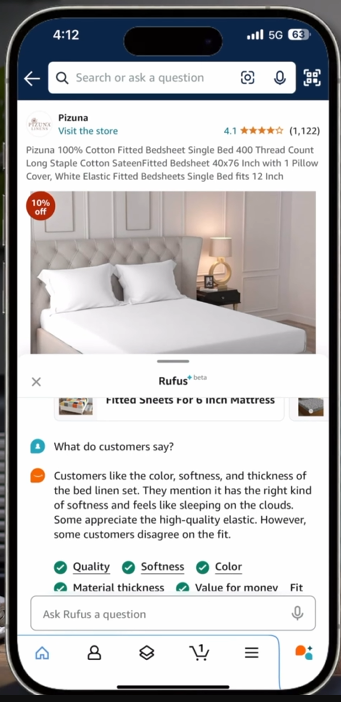
Review volume and review quality are both COSMO signals, but quality matters more than you might expect. Amazon's AI assistant specifically compiles review summaries when customers ask "what do people say about this product?" — and it draws from the actual review text, not an aggregate star rating. A product with 50 detailed, specific reviews ("used this for three weeks of backpacking in Nepal — held up perfectly") trains COSMO far more richly than a product with 300 five-star reviews that all say "great product!"
To improve review quality, the Amazon Vine program is the most reliable mechanism for verified, detailed feedback on new products. For existing ASINs, Amazon's post-purchase messaging (via Request a Review) generates more responses than seller-led follow-up email campaigns since the 2022 policy tightening, but the content of those reviews is not directly influenceable. The best long-term lever is product quality — a product that genuinely solves a specific problem generates specific, useful reviews naturally.
Is Alexa for Shopping Replacing Amazon's Standard Search?
Is Alexa for Shopping replacing Amazon search?
No — Alexa for Shopping runs in parallel with Amazon's standard keyword search, not as a replacement. The two systems serve different query types: keyword search handles specific, product-ready searches ("Nike running shoes size 10"), while Alexa for Shopping handles intent-based, conversational, and research-stage queries ("what shoes should I wear for a 5K?"). Most purchase journeys on Amazon still begin with keyword search. Alexa for Shopping is capturing a growing share of the discovery and consideration phase.
Amazon's current direction is to make Alexa for Shopping the primary interface for research-stage shopping — where customers are figuring out what to buy, not what specific product to search for. Keyword search remains dominant for buyers who already know exactly what they want. The practical implication for sellers is that the two systems require different optimization strategies running simultaneously: keyword density and purchase signals for traditional search, use-case clarity and content depth for AI-driven discovery.
What is changing is the share of queries. Amazon's internal data from 2025 indicated that a significant percentage of mobile app shopping sessions now involve at least one Alexa for Shopping interaction — typically at the category or problem definition stage before a final keyword search. As the assistant matures and becomes the default entry point in the Amazon app for undecided shoppers, its influence over final purchase decisions will grow. Getting your products into its recommendation set now, while competition is still light, is a durable first-mover advantage.
How to Test Whether Your Listing Is Alexa for Shopping-Ready
The most direct test is also the most practical: open the Amazon app, tap the Alexa for Shopping panel (bottom of the home screen on the latest app version), and query your own product category the way a customer would — not with your product's keywords, but with the problem it solves or the person who would buy it. If your product does not appear in the recommendations for queries it should answer, your listing has content gaps COSMO cannot bridge.
A structured self-audit before that test covers the following:
| Listing Element | AI-Ready Standard | Common Gap |
|---|---|---|
| Title | Includes at least one use case or target user alongside features | Features only, no context |
| Bullet Points | 5 bullets addressing who/what/why/how questions in natural language | Keyword phrases, no explanatory sentences |
| Description / A+ Content | Complete, with Brand Story filled out and comparison module present | Empty description with A+ added but Brand Story blank |
| Q&A | 10+ answered questions covering top use cases and common objections | 2-3 unanswered questions from customers |
| Reviews | 50+ reviews with detailed, use-case-specific text | Few reviews or one-line reviews only |
| Category Attributes | All mandatory AND relevant non-mandatory fields complete | Mandatory-only fields filled |
What YourSeller Does Differently for AI-Ready Listings
The transition from keyword-driven to intent-driven search on Amazon is not a future trend — it is a current, measurable shift in how a growing share of buyers discover products. At YourSeller, our listing optimization work has evolved alongside this shift: we now audit every listing against both traditional A9/A10 keyword indexing and Alexa for Shopping content readiness as standard practice, not as a separate service.
In practice, that means rewriting titles to include use-case context, structuring bullets as intent signals rather than keyword lists, proactively seeding the Q&A section with the questions COSMO is most likely to be asked for your category, and building an A+ Content Brand Story that accurately maps your product to the customer types and situations it serves. The 90-day sprint we use to onboard new clients typically includes a complete content audit and rewrite as the first step — because without AI-ready content, the PPC and ranking work we do afterward is working harder than it needs to.
If your listings were optimized before 2024 and have not been updated since, they were written for a search environment that no longer fully describes what Amazon has become. The good news is that AI-ready optimization and conversion optimization are largely the same thing — clearer, more specific content that explains use cases to COSMO also explains those same use cases to undecided human buyers.
Frequently Asked Questions
What is the difference between Amazon Rufus and Alexa for Shopping?
They are the same product at different points in its development. Amazon launched the AI shopping assistant as "Rufus" in early 2024. In January 2026, Amazon rebranded it as "Alexa for Shopping" and integrated it more deeply into the main Alexa platform, expanding its capabilities beyond product search to include order tracking, deal alerts, and purchase history queries. The underlying technology — the COSMO reasoning model — remained the same through the rebrand.
Does Alexa for Shopping affect my regular Amazon search rankings?
Directly, no — Alexa for Shopping recommendations and standard keyword search results are separate systems with separate ranking logic. Indirectly, yes: products that receive traffic and conversions from Alexa for Shopping recommendations accumulate purchase velocity signals that benefit their keyword search rankings. AI-driven discovery is increasingly a top-of-funnel channel that feeds the bottom-of-funnel performance metrics traditional search measures.
Can I Turn Off Amazon Rufus / Alexa for Shopping for My Products?
No — there is no seller-side setting to opt products out of Alexa for Shopping recommendations. Products are included or excluded based on COSMO's assessment of content relevance, review quality, and performance signals. The only control sellers have is the quality of their listing content — which is also the lever that determines whether a product is recommended or overlooked.
How many reviews do I need to appear in Alexa for Shopping results?
There is no published minimum threshold, but in practice, products with fewer than 20–30 reviews appear significantly less often in Alexa for Shopping recommendations compared to competing products with higher review counts in the same category. The more important factor is review quality and specificity — detailed reviews that mention specific use cases give COSMO more data to match against conversational queries than a larger volume of one-line reviews.
Does A+ Content help with Alexa for Shopping?
Yes, particularly the Brand Story module and comparison tables. COSMO reads A+ Content as part of its overall content index for a product — Brand Story adds brand-level context, and comparison modules add structured differentiation data between variants. Listings with complete A+ Content consistently rank higher in Alexa for Shopping results compared to equivalent listings using only standard detail page content, all other signals being equal.
What Amazon listing fields matter most for COSMO and AI search?
In order of impact: title (use-case framing), bullet points (natural-language intent signals), Q&A (answered questions with specific use-case language), review text (organic use-case descriptions), A+ Content Brand Story, and product description. Backend keywords influence traditional search indexing but are not directly read by COSMO. Non-mandatory category attributes — material, age range, intended use — feed COSMO's classification of the product and should be completed even when not required for listing activation.
The Bottom Line on Alexa for Shopping
The practical advice here is not complex: write your listings for a customer who is explaining what they need, not for a customer who already knows your product's name. COSMO rewards listings that make it easy to answer the question "is this the right product for me?" — and that is also what converts undecided human buyers. Alexa for Shopping did not create a new optimization requirement so much as it made visible what good listing content already needed to do.
The sellers who will capture the most value from AI-driven discovery are the ones who treat listing content as an ongoing asset, not a one-time setup task. As Alexa for Shopping handles a growing share of research-stage queries, products with richer, more specific content will compound their advantage — more AI recommendations, more reviews describing specific use cases, better COSMO context, more recommendations again.
If your current listings were built for the Amazon of two years ago, they were built for a narrower version of the platform. Reach out to YourSeller for a listing audit — we will tell you exactly where your content stands against both traditional search and Alexa for Shopping standards, and what a 90-day optimization sprint would look like for your catalogue.
