
How to List Products on Flipkart: Complete Step-by-Step Guide (2026)

Knowing how to list products on Flipkart is one of the first — and most critical — skills any seller needs to master. A well-built listing determines whether your product shows up in Flipkart search, passes quality check without delays, and converts browsers into buyers. Get it wrong, and you are invisible before the sale even begins.
This guide covers the complete Flipkart product listing process from scratch: prerequisites, single vs. bulk listing, every attribute across all three sections, image guidelines, procurement types, QC timelines, and optimization tips that most sellers overlook.
Quick answer: To list a product on Flipkart, log in to your seller account → go to My Listings → Add New Listing → Add a Single Listing → select your approved category and brand → fill in the three sections (Price/Stock/Shipping, Additional Description, and Product Images) → submit for QC. Approval typically takes 24–48 hours.
Prerequisites: What You Need Before You Start Listing
Before you can add a single product, three things must already be in place on your Flipkart seller account:
- Seller account active: Registered at seller.flipkart.com with GST number, PAN, and bank account verified.
- Brand approval: Flipkart requires brand authorization for most categories. You will need a brand authorization letter, invoice copy, or trademark certificate depending on your category.
- Category approved: Your brand must be approved specifically for the category you plan to sell in. Selecting a category outside your approved list will trigger a fresh brand approval request and delay your go-live.
Once these are confirmed, you are ready to begin Flipkart product listing.
Single Listing vs. Bulk Listing on Flipkart: Which One Should You Use?
Flipkart gives sellers two methods to add products to their catalog. Choosing the right one saves significant time.
| Feature | Single Listing | Bulk Listing |
|---|---|---|
| Best for | New sellers, small catalog (1–20 products) | Large catalog, wholesalers, established brands |
| Method | Fill product details manually via seller dashboard | Download Excel template, fill offline, upload |
| Control | High — review every field individually | Medium — errors in Excel can affect multiple listings |
| Speed | Slower for large inventory | Much faster for 50+ products |
| Error risk | Lower — instant error feedback | Higher — batch errors delay all listings |
| Recommended when | Starting out, listing premium or complex products | Scaling quickly, fashion, accessories, FMCG |
For bulk listing, Flipkart provides a pre-formatted Excel template from the Catalog Manager. Download it, fill in SKU, brand, style code, and size per the index sheet instructions, then re-upload. The process mirrors the single listing flow except for data entry method.
How to List Products on Flipkart: Step-by-Step
The following steps apply to single listing — the most common method for new and growing sellers.
Step 1: Navigate to My Listings
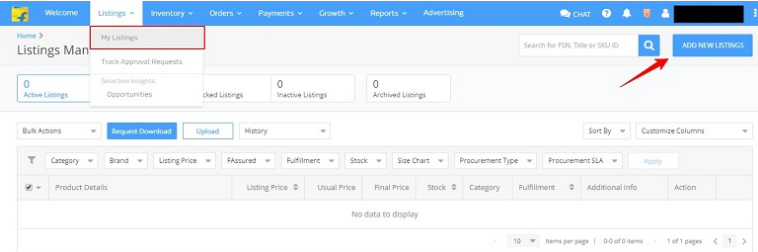
Log in to your Flipkart Seller Hub. Go to the Listings section in the left navigation and click My Listings. On the listing management page, click Add New Listings, then select Add a Single Listing.
Step 2: Select Category and Brand
Choose the product category that matches your brand's approved category on Flipkart. You can search by product name, browse manually, or select from Flipkart's top suggested categories. If you select a category outside your brand's approval, Flipkart will redirect you to reapply for brand authorization — which adds delays.
Once the category is set, choose your brand from the approved brand list under Brand Selection. Use the search box to find your brand name quickly.

Step 3: Fill Section 1 — Price, Shipping, and Stock
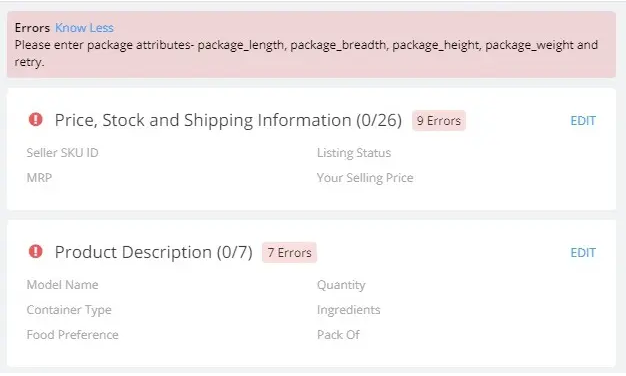
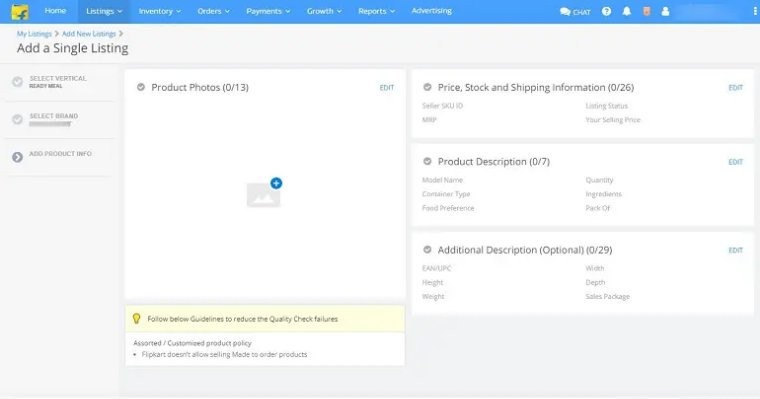
This is the most detailed section of the Flipkart listing process. It contains 26 attributes divided into 9 sub-headings. Fields marked with (*) are mandatory — leaving them blank or filling them incorrectly will generate errors at submission.
Seller SKU ID
Your SKU ID (Stock Keeping Unit) is an alphanumeric identifier you assign to each product — for example, AF01, MM101, or SHIRT-RED-L. It is not visible to customers, but Flipkart uses it for inventory tracking, pricing updates, and order fulfillment. Keep SKU IDs consistent and descriptive for easy management as your catalog grows.
Listing Status
Set this to Active. Only active listings are visible to customers in Flipkart search. Inactive listings are saved but will not appear on the marketplace.
Pricing: MRP and Selling Price
Enter the Maximum Retail Price (MRP) of your product in INR. Then set your selling price — this must always be lower than the MRP. Before finalizing your selling price, account for Flipkart's commission fees, packaging cost, and Ekart shipping charges so your margin is protected.
Procurement Type in Flipkart
Procurement type is one of the most misunderstood fields in the Flipkart listing process. It tells Flipkart how quickly you can make the product ready for dispatch once an order is placed. Choosing the wrong option leads to SLA breaches and seller penalties.
| Procurement Type | What It Means | Best For |
|---|---|---|
| Instock | Product is physically available in your warehouse and ready to ship immediately | Most sellers — standard choice for available inventory |
| Express | Faster fulfillment commitment; product must be dispatched same day or next day | High-demand, fast-moving products with consistent stock |
| Domestic Procurement | Product is sourced locally after the order is placed, not pre-stocked | Made-to-order or locally sourced products |
For most sellers starting out, choose Instock and keep physical stock ready before making listings live.
Procurement SLA in Flipkart
SLA stands for Service Level Agreement — the number of days you commit to making the product ready for pickup by Flipkart's logistics partner. The standard acceptable value Flipkart requires is 2 days. Consistently failing to meet your Procurement SLA results in seller performance penalties and can reduce your listing visibility in search.
Stock Quantity
Enter the number of units you have available. You can enter zero if the product is temporarily out of stock — the listing will remain saved but will not be visible to buyers until stock is updated.
Shipping Details
Select Flipkart as your shipping provider. Flipkart uses its own logistics arm, Ekart, for most deliveries. Selecting a non-Flipkart option will generate an error at this stage. Self-shipment is available in select categories, but Flipkart-managed logistics is recommended for reliability and nationwide reach.
Sales Package in Flipkart: What Does It Mean?
The Sales Package field describes what the buyer receives in the box — not just the product itself. For example: "1 T-Shirt, 1 brand tag" or "1 set of 6 glasses, 1 box." This field directly impacts customer satisfaction and return rates. Products where the received item does not match the declared sales package frequently trigger return requests and negative reviews.
Step 4: Fill Section 2 — Additional Product Description
This section has 29 optional attributes divided into four categories: General, Dimensions, Box, and Additional Features. Although optional, filling these fields increases your product's discoverability in Flipkart's internal search and gives buyers more confidence before purchasing.
- General: Brief product description, relevant search keywords (maximum 3 words; do not include brand names), and other general specifications.
- Dimensions: Height, width, depth, and weight of the product. These must match the values in your product images — discrepancies cause QC failure.
- Box: Product name and list of all items included in the package. This directly connects to the Sales Package field from Section 1.
- Additional Features: Any government approvals, certifications, or unique features specific to your product.
Step 5: Upload Product Images — Flipkart Image Guidelines
Product images are the single biggest conversion factor on Flipkart. You can upload up to 13 images per listing. At a minimum, include front, back, and side views. Lifestyle images and infographics that show scale, usage, or features significantly improve click-through rates.
| Parameter | Flipkart Requirement |
|---|---|
| Minimum resolution | 500 × 500 pixels (1000 × 1000 recommended for zoom) |
| Background | White or light solid background preferred |
| MRP on image | Not allowed — causes immediate QC failure |
| Watermarks or logos | Not allowed on main product images |
| Color accuracy | Must match actual product — incorrect CMYK triggers rejection |
| Mandatory views | Front and back minimum; category-specific requirements may vary |
| Maximum images | 13 images per listing |
For apparel and footwear categories, Flipkart may also require model images — always check the category-specific image guidelines in your seller dashboard before uploading to avoid QC delays.
Step 6: Submit for Quality Check (QC)
Once all three sections are complete, click Send to QC in the bottom right corner. If you are not ready, save as a draft and return later. Once submitted, a Request ID is generated in your seller account to track approval status.
Understanding the Flipkart QC Process

What Is QC in Flipkart?
Quality Check (QC) is Flipkart's internal review process that verifies every new listing meets platform guidelines before it goes live. The QC team checks images, product information accuracy, pricing compliance, and category requirements. No listing goes live without passing QC — making it a critical gate in the Flipkart listing process.
How Long Does Flipkart QC Take?
Standard QC processing time on Flipkart is 24 to 48 hours after submission. Some categories may qualify for instant QC if your seller account has a strong performance history. If errors are found, Flipkart sends the listing back with specific error tags identifying exactly which fields need correction — not a blanket rejection.
What Is a Request ID in Flipkart Seller Account?
Once you submit a listing for QC, your seller dashboard generates a Request ID — a unique tracking number for that specific listing's review. Use this ID to check approval status from within the seller panel. If you have multiple listings under review simultaneously, the Request ID is the quickest way to identify each one's progress.
Common Reasons a Listing Fails Flipkart QC
- MRP printed or visible anywhere in the product image
- Blurred, low-resolution, or poorly lit product images
- Front or back product image missing
- Product dimensions in the image do not match values entered in listing attributes
- Incorrect or missing product weight
- Government license number missing (required for regulated categories: food, electronics, health products)
- Manufacturing date, expiry date, or manufacturer information missing from the image where required
- Incorrect CMYK color rendering — product appears a different shade on image vs. actual item
When a listing fails QC, correct only the flagged fields using the error tags Flipkart provides, then resubmit. Avoid editing non-flagged fields unnecessarily — it can restart the review clock.
Flipkart Listing Optimization: 6 Things to Do After Going Live
Getting your listing approved is step one. Ranking it within Flipkart search is what actually drives sales. These six factors make the biggest difference:
- Optimize your product title: Use buyer-intent keywords in your title — describe the product by brand, type, key feature, and size or color the way customers actually search on Flipkart. Avoid keyword stuffing; Flipkart's algorithm penalizes it.
- Use backend search keywords: The Additional Description section allows up to 3 search keywords. Use terms buyers type that are not already in your title — and never use brand names in this field, as Flipkart explicitly disallows it.
- Price competitively: Flipkart's search algorithm surfaces price-competitive listings higher. Use Flipkart's pricing calculator to balance margin and visibility, especially before high-traffic events like Big Billion Days.
- Enable Flipkart Fulfillment: Listings fulfilled through Ekart receive preferential ranking and earn the Flipkart Assured badge, which significantly improves click-through rates from buyers.
- Manage reviews actively: Higher-rated products rank better in Flipkart search. Respond to negative reviews and resolve buyer complaints quickly to protect your seller rating.
- Maintain consistent stock: Listings that go out of stock frequently lose their ranking positions. Build a buffer stock — especially for top-performing SKUs ahead of sale seasons.
Frequently Asked Questions
What is procurement type in Flipkart and which one should I choose?
Procurement type tells Flipkart how you source inventory to fulfill orders. Instock means the product is already in your warehouse and ready to ship. Express commits you to same-day or next-day dispatch. Domestic Procurement is for products sourced locally after an order is placed. For most sellers with physical stock, Instock is the right and most common choice — it is predictable, manageable, and carries realistic SLA expectations.
What is Procurement SLA in Flipkart and what happens if I miss it?
Procurement SLA is your committed lead time — measured in days — to prepare an order for Flipkart's pickup agent. The standard acceptable value is 2 days. Missing your SLA consistently leads to seller performance score penalties, reduced visibility in search results, and in severe cases, listing suspension. Always set a realistic SLA based on your actual fulfillment speed, not an optimistic target.
What does "sales package" mean in a Flipkart listing?
Sales Package refers to exactly what the buyer receives in the box — the complete contents of the shipment. For example: "1 water bottle, 1 lid, 1 cleaning brush" or "1 pair of shoes, 1 dust bag." This must match what is physically shipped every time. Mismatches between the declared sales package and what is delivered are one of the most common causes of returns and negative seller ratings on Flipkart.
How long does Flipkart QC take and what is a Request ID?
Flipkart QC takes 24–48 hours after submission. Once submitted, your seller dashboard generates a Request ID — a unique tracking number for that specific listing's review. Use this ID to check approval status. If QC fails, Flipkart returns the listing with error tags on the specific fields that need correction. Instant QC is available for select categories on accounts with a strong seller history.
What is a Seller SKU ID in Flipkart and how should I create one?
A Seller SKU ID is a unique alphanumeric identifier you assign to each product for internal tracking — for example, SHIRT-BLK-M or BTL-500ML-RED. It is not visible to buyers. Flipkart uses it to track inventory, pricing changes, and order data. Keep SKUs short, logical, and consistent — typically structured by product type, color, and size. Avoid spaces and special characters in SKU IDs.
Can I list products on Flipkart without a brand name?
Yes. Generic or unbranded products can be listed on Flipkart under certain categories without brand documentation. However, for branded products, Flipkart requires brand authorization — a brand authorization letter, invoice copy, or trademark certificate — before you can list under that brand's name. Attempting to list a branded product without approval will block the listing at the category selection step and trigger a brand approval request.
Ready to Sell on Flipkart — and Scale Further on Amazon?
Most sellers spend hours troubleshooting QC failures, procurement type errors, and listing rejections that an experienced marketplace team resolves in minutes. At YourSeller Agency, we handle end-to-end product listing and cataloging for Amazon and Flipkart sellers — from image guidelines compliance and SKU structure to procurement type setup and ongoing marketplace management — so your products go live faster and rank where buyers are looking.
Our 90-day sprint model means you see measurable results without committing to a long-term retainer. No contracts. Just proof, then scale.

