
Amazon Account Management Checklist
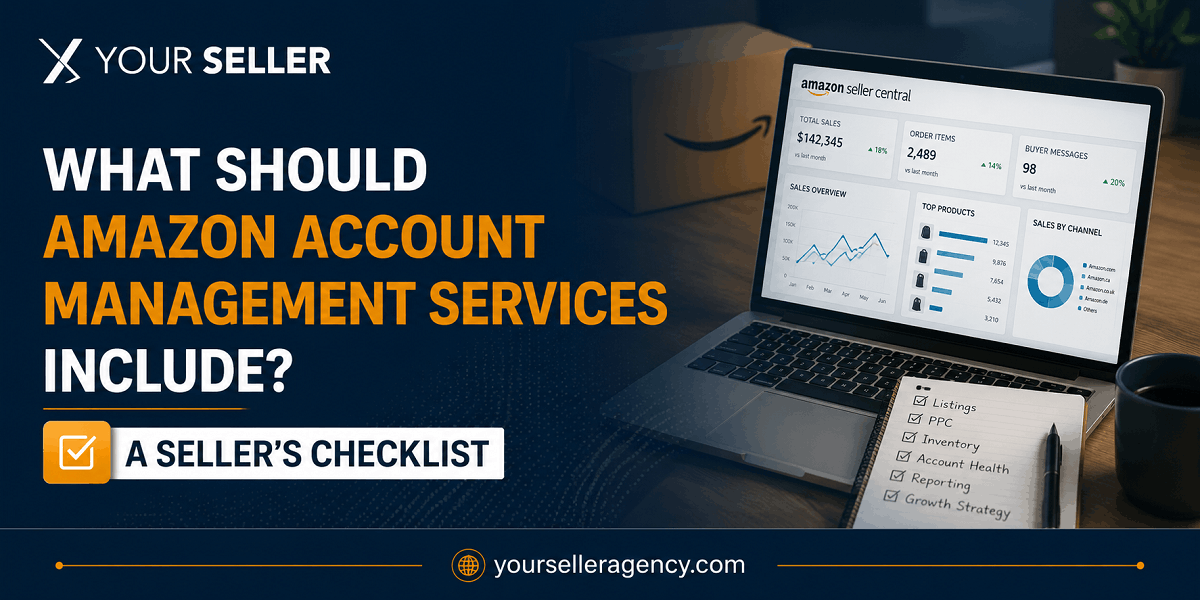
Many brands hit a painful plateau after launching their storefront. The initial excitement fades when sales start coming in, but profit margins begin to vanish. The daily reality of running an ecommerce business quickly shifts from building a brand to fighting constant operational fires. At this critical stage, the core problem is rarely a lack of hard work from your internal team. The actual issue is that your brand has outgrown the scattered, disconnected support it has been receiving.
You might have one freelancer running your paid ads. Another team member might handle inventory logistics. A third person might upload new products without understanding search intent. That disjointed approach creates massive blind spots. Sellers often assume they are buying full support when they piece together different contractors. In reality, they are only managing isolated fragments of the marketplace.
A truly profitable Amazon strategy relies on a tightly connected ecosystem. Your advertising, product catalog, pricing models, inventory pipelines, and account health metrics must operate in total unison. That deep synchronization is why ambitious brands require professional Amazon account management services.
This comprehensive guide breaks down what a premier agency should execute behind the scenes. We will explore what genuine support looks like, what red flags to avoid, and the exact questions you must ask before handing over the keys to your storefront.
This breakdown is also incredibly valuable for newer brands navigating their initial Amazon seller registration who want to build a flawless operational foundation from day one.
Why Fragmented Support Destroys Profit Margins
The term "account management" gets thrown around loosely in the ecommerce space. That ambiguity is why so many business owners end up trapped in expensive retainer contracts that deliver zero net growth. Broad promises to boost your sales mean absolutely nothing if the agency does not understand how your specific category operates.
Many service providers focus exclusively on Pay-Per-Click campaigns. Others provide basic administrative support to keep your Seller Central dashboard free of errors. Some agencies offer listing uploads but completely ignore conversion rate optimization. They will gladly send you a dense spreadsheet of monthly data without offering a single strategic recommendation on what you need to change next week.
This fragmented approach drains your capital rapidly. A business owner might sign a contract expecting an all-in-one growth partner, only to find out that fixing suppressed listings costs extra. They might discover that their agency does not monitor competitor pricing or track inventory limits.
When you hire a team for online marketplace management, you need a partner who views your account as a living, breathing retail system. If your product pages feature weak imagery, driving expensive ad traffic to them is a complete waste of money. If your warehouse runs out of stock, your organic keyword ranking drops to zero regardless of how well your ads were performing yesterday. A premier Amazon seller agency connects all of these dots to protect your bottom line.
The Ultimate Full Service Agency Blueprint
Before you sign any agreement, you need a strict checklist to verify what the agency will execute on a daily and weekly basis. True account management goes far beyond basic maintenance. It requires aggressive optimization across five specific operational pillars.
1. Audit the Entire Account Architecture First
Before an agency touches your advertising budget or changes a single word on your product pages, they must understand your current operational reality. A professional partnership always begins with a deep forensic audit.
An elite agency will tear down your historical performance metrics to find the hidden leaks in your profit margins. A professional partnership should always start with a comprehensive forensic audit to grasp your current operational status. Elite agencies will scrutinize your historical data to pinpoint hidden profit leaks. This includes evaluating organic versus paid sales to confirm ads aren't merely cannibalizing free orders, reviewing Total Advertising Cost of Sales (TACoS) relative to total revenue, and generating granular SKU-level reports to distinguish profitable products from those losing money.
The audit must also cover your technical foundation. The team should check your dashboard for active policy violations, hidden listing suppressions, and stranded inventory. They need to review your Inventory Performance Index score to ensure Amazon will not restrict your future shipping capacity. They must analyze your Voice of the Customer dashboard to spot recurring product defects or return trends.
Growth strategies must begin with a clear diagnosis. If an agency suggests increasing your ad spend without first auditing your account health and profit margins, they are operating blindly.
2. Treat Product Pages as Dynamic Conversion Assets
Your product listings are your digital salespeople. A full-service agency manages these pages as highly tuned performance assets rather than static text files.
Comprehensive Amazon product listing and cataloging requires a deep understanding of human psychology and search engine behavior. The agency must craft titles that weave high-volume search phrases into a naturally readable format. They must write bullet points that immediately address common buyer objections and highlight unique product benefits within the first few words.
True optimization also extends far beyond the visible text. The agency must structure your backend search terms flawlessly. They need to research alternate spellings, Spanish search phrases, and complementary product terms to capture hidden traffic. They must ensure your parent-child variation structures are built correctly so reviews aggregate properly, and shoppers can navigate your color or size options without friction.
Visual conversion is just as critical. Your agency should direct the creation of your lifestyle images, infographics, and comparison charts. They must build out premium A+ Content modules that validate your brand authority and cross-sell your other items. Uploading a product feed is basic data entry. Optimizing a product for maximum conversion requires continuous testing and refinement.
3. Connect Advertising Metrics to Overall Profit
Advertising on the platform has become incredibly complex and expensive. Managing your campaigns should never happen in isolation from your inventory or pricing strategies.
Robust Amazon marketing services must encompass the entire advertising ecosystem. The agency should deploy highly segmented Sponsored Products, Sponsored Brands, and Sponsored Display campaigns. They need to utilize precise product targeting to steal market share directly from your competitors' detail pages. They must execute aggressive negative keyword harvesting to instantly shut down search terms that generate clicks without driving sales.
More importantly, a top-tier agency understands the context behind the numbers. They know that a high Return on Ad Spend on a specific campaign is meaningless if the product itself has a terrible profit margin. They understand when to pause a campaign because a product is running low on stock. They know when to aggressively bid on top-of-search placements to force a new product into the organic ranking algorithms.
Every single advertising decision must tie back to your total account profitability. If an agency only reports on their ad-attributed sales and ignores how their spending impacts your overall net margin, they are not acting as a true growth partner.
4. Defend the Buy Box and Monitor Stock Limits
Driving massive traffic and achieving a high conversion rate means absolutely nothing if you cannot fulfill the orders. Inventory management and pricing strategy are the lifeblood of your Amazon business.
Your agency must monitor your daily sales velocity against your available warehouse stock to project accurate reorder dates. They need to alert you weeks in advance when a top-selling item is at risk of a stockout. A stockout is catastrophic for your organic search rankings. When you run out of inventory, Amazon immediately drops your product from the search results. Earning that placement back requires massive ad spend and weeks of lost momentum.
Pricing and Buy Box ownership require the same level of daily vigilance. The team needs to watch for rival price shifts and active discount strategies across the marketplace. They need to monitor your listings for unauthorized third-party sellers who might hijack your Buy Box by undercutting your price. They should strategically deploy digital coupons and prime exclusive discounts to temporarily boost conversion rates during slow sales periods.
Furthermore, the agency must monitor your customer reviews and seller feedback daily. A sudden drop in a product rating will paralyze your conversion rate instantly. The team should track return reasons to identify manufacturing defects early and adjust listing copy to set better customer expectations.
5. Deliver Strategic Roadmaps Instead of Raw Data
Data without context is completely useless to a busy business owner. You do not need an agency to send you an automated spreadsheet that you could easily download yourself from Seller Central.
A professional reporting structure translates raw metrics into clear strategic action plans. Your weekly and monthly reports should highlight your exact Total Advertising Cost of Sales and your blended profit margins across your entire catalog. The report should track your organic keyword ranking improvements over time. It should show your Buy Box win percentage and your unit session conversion rates.
The real value comes from the analysis attached to those numbers. The agency should explicitly tell you why a specific metric moved and what they plan to do about it next week. They should identify which specific SKUs are ready for a budget increase. They should flag which products need an image overhaul to fix a dropping conversion rate. They must outline which experimental ad campaigns failed and how they reallocated that wasted spend.
That is the profound difference between passive data reporting and active account leadership. Your agency should remove the guesswork from your daily operations.
Red Flags to Watch for During Agency Pitches
Finding the right partner requires asking hard questions during the vetting process. Many agencies excel at sales pitches but fail at daily execution. You must learn to spot the warning signs of a weak service provider before you sign a contract.
Avoid any agency that refuses to provide a clear, itemized scope of work. If their deliverables are vague or rely heavily on buzzwords, you will inevitably face hidden fees and constant arguments over what is actually included in your monthly retainer.
Be highly skeptical of any team that guarantees specific revenue targets or exact organic ranking positions within a specific timeframe. The Amazon marketplace is incredibly volatile. Competitors change their prices daily, and search algorithms update constantly. A legitimate agency promises strict operational discipline and data-driven execution, not impossible financial guarantees.
Watch out for proposals that heavily emphasize ad management but completely ignore account health monitoring and catalog hygiene. Ads alone cannot fix a fundamentally broken business. If an agency does not care about your inventory limits, your profit margins, or your listing suppressions, they are only interested in spending your money to collect a percentage of your ad spend.
Finally, reject any agency that refuses to discuss SKU-level profitability. If their entire strategy revolves around top-line gross revenue, they will inevitably scale your business into unprofitability. Growth is only valuable if you actually retain the cash you generate.
Amazon Account Management Services Checklist Table
|
Service Area |
Should It Be Included? |
Why It Matters |
|
Account audit |
Yes |
Finds sales, profit, listing, catalog, and ad issues before action |
|
Seller Central management |
Yes |
Keeps the account operationally stable |
|
Listing optimization |
Yes |
Improves discoverability and conversion |
|
Amazon SEO |
Yes |
Helps products appear for relevant buyer searches |
|
PPC management |
Yes |
Drives targeted traffic and supports growth |
|
A+ Content support |
Yes |
Improves product education and brand trust |
|
Brand Store support |
For brand-registered sellers |
Builds a stronger Amazon brand destination |
|
Catalog management |
Yes |
Reduces errors, suppression, and structural issues |
|
Inventory and pricing monitoring |
Yes |
Protects sales continuity and margin |
|
Account health monitoring |
Yes |
Reduces risk of performance or policy disruptions |
|
Review monitoring |
Yes |
Helps identify trust and product experience issues |
|
Competitor analysis |
Yes |
Shows where the brand stands in the marketplace |
|
KPI reporting |
Yes |
Connects performance data to decisions |
|
Growth strategy |
Yes |
Turns management into a scalable direction |
Direct Answers to Your Top Agency Questions
Navigating the agency landscape can feel overwhelming. Here are clear, straightforward answers to the most critical questions sellers ask when seeking professional management.
1. What exact tasks should a full-service agreement cover?
Your agreement must cover initial forensic audits, daily Seller Central issue resolution, continuous listing optimization, comprehensive advertising management, catalog error fixing, inventory velocity tracking, and strategic performance reporting.
2. Does an advertising agency do the same thing as a management agency?
Absolutely not. An advertising agency exclusively builds and manages your paid search campaigns. A management agency oversees your entire business ecosystem. They handle your ad spend while simultaneously optimizing your product pages, fixing technical catalog errors, and monitoring your account health metrics.
3. How quickly should a brand expect to see a return on their agency investment?
You should see immediate improvements in your wasted ad spend and catalog hygiene within the first thirty days. However, meaningful, profitable revenue growth typically requires a full ninety-day sprint to properly audit the account, test new conversion strategies, and aggressively scale the winning product lines based on hard data.
4. Why is daily account health monitoring so critical for sellers?
Amazon heavily automates its policy enforcement. A sudden spike in customer returns or a false intellectual property claim can result in your top-selling listing being deactivated overnight. Daily monitoring ensures these technical flags are addressed immediately before they cause catastrophic revenue loss or permanent account suspension.
Take Control of Your Storefront Today
Scaling a brand on the world's most competitive retail platform requires intense focus, deep technical expertise, and relentless daily execution. You cannot build a sustainable empire by relying on disconnected freelancers or reactive, partial support strategies. Growth requires a unified system where your advertising, inventory, and catalog health work together flawlessly.
At YourSeller, we build high-performance brand management plans designed specifically for growth-focused companies navigating the US, UK, and India arenas. We replace chaotic guesswork with absolute operational clarity. Our teams audit your profit leaks, rebuild your conversion assets, and scale your brand using strict, margin-focused data.
Stop losing market share to competitors with inferior products but better account operations. Reach out to YourSeller today to request a comprehensive teardown of your current marketplace strategy, and let us build your blueprint for profitable, predictable growth.
